
Kiowa County VINELink Coverage
VINE means Victim Information and Notification Everyday. The Kansas Attorney General’s VINE page describes a free, voluntary, and confidential service available online, by telephone, and through the VINELink mobile app. For Kiowa County, its key role is a one-person adult county-jail custody check and notification service.
Kansas VINE does not include KDOC offenders housed in state prisons. A person associated with a Kiowa booking may be physically housed by another participating county because the local roster has a Location field. VINE may still help, but note which agency reports the event. If the person entered Kansas prison, use KASPER and KDOC instead.
| Custody path | Use VINE? | Follow-up |
|---|---|---|
| Adult Kiowa jail booking | Yes, if reported by a participating jail | Kiowa or physical custodian |
| KDOC state prison | No | KASPER and KDOC |
| Federal sentenced prison | No | BOP locator |
| Federal pretrial or ICE | No | Court, USMS/facility, or ICE |
Search a Kiowa County VINE Record
Open Kansas VINELink from the official state page. The interface may use one address for search, results, and registration. Labels can change. Use the name and identifier fields currently offered, and compare several details before selecting a person with a common name.
- Select Kansas if the opening workflow asks for a state, then choose offender search.
- Enter the adult county-jail person’s name or an identifier offered by the interface.
- Review close matches and compare identifiers, reporting agency, and facility context.
- Open the matched record and copy its status or event wording exactly.
- Check the event against Kiowa, the roster Location, and the court when exact release type matters.
A no-match does not prove release. Spelling, timing, a move to another system, or loss of an active record can all explain it. The Kiowa County released inmates search path shows how to pair the roster, court, phone, and formal-record channels.
The successful manifest capture comes from the official Kansas VINELink interface.
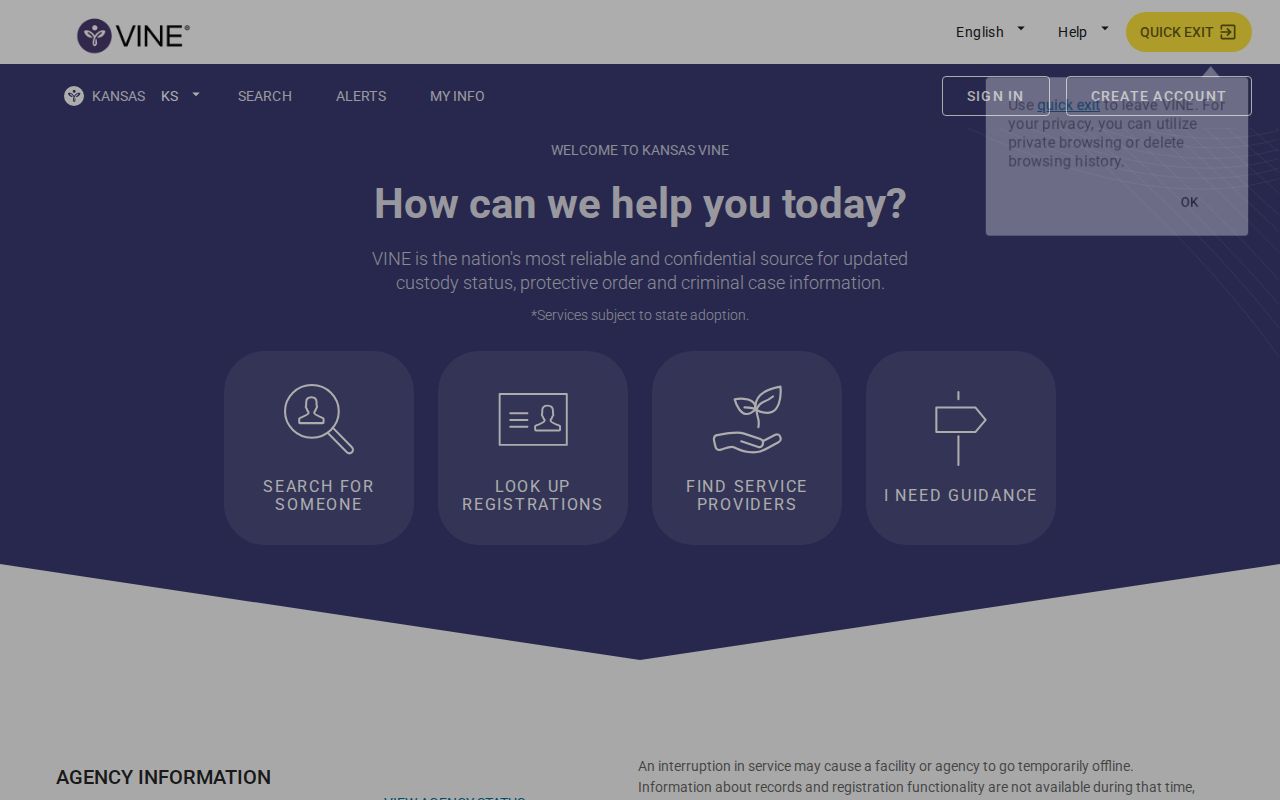
The interface supports the search route, while the reporting county jail supplies the event context.
What Kiowa County VINE Reports
VINE’s value is the custody status or custody-change event reported for the matched county-jail person. Official Kansas materials support alerts for release, transfer, escape, and other changes. Static guidance did not provide a safe released-result example with stable labels, so do not promise that a specific date field or phrase will appear.
| Result element | What it can establish |
|---|---|
| Person identifiers | Whether the result likely belongs to the intended adult |
| Custody status or event | The current change reported by a participating jail |
| Reporting agency | Which jail supplied the event and where follow-up starts |
| Notification options | Phone, text, email, or app methods currently offered |
A “release” from one jail does not always mean freedom from every hold. It can coexist with transfer, another warrant, or custody in a different system. Kiowa’s distributed housing makes the reporting agency crucial. Ask whether the booking ended through bond, court order, time served, sentence completion, transfer, or another event.
Note: A VINE event supplies timely notice, while the jail event log is the durable source for release time, type, and destination.
Register Kiowa County Release Alerts
Registration ordinarily starts while the person is still shown in custody. Select the correctly matched record, then choose among the delivery methods currently offered. Official Kansas materials support phone, text, email, and in-app alerts. Enter only your own contact information and keep confirmation details private.
- Open the matched in-custody record and select its notification control.
- Choose phone, text, email, or app delivery and enter the requested contact details.
- For phone registration, create a four-digit PIN. It is an acknowledgment code.
- On an automated call, listen, enter the PIN followed by
#, and acknowledge the notice. - For email, watch for one custody-change message. Email requires no PIN.
If the person has already disappeared, registration may no longer be available. Do not treat that as proof of release. Request the historical booking and release event from Kiowa or the physical custodian. Follow a transfer alert to the destination agency.
Confirm Kiowa County VINE Events
Use the VINE event as a prompt to check its source. Call the Kiowa jail at 620-723-4155 with the name, booking number, and last Location. Ask whether that booking closed, when it closed, what event closed it, and whether the person went to another agency. If another county housed the person, Kiowa can identify which custodian owns the log.
The court docket can explain legal authority, but may not state the minute physical processing ended. A narrow records request can seek the release date, time, type, releasing custodian, and receiving agency if public. VINE is built for notice, not archival certification.
For a KDOC prisoner, use KASPER and KDOC. For a federal sentenced prisoner, use BOP. Federal pretrial custody generally requires the federal docket and USMS or facility route. ICE’s locator is current-focused, not a historical release archive.
Kansas VINE Phone Number Conflict
Official Kansas materials contain a one-digit conflict. The current brochure and a 2025 Attorney General release support 1-866-574-8463. The Attorney General landing page displays 1-866-574-7463. The better-supported operational number is 1-866-574-8463, with TTY at 1-866-847-1298.
Prefer the number supported by both newer official sources, and recheck the state materials if a call fails. Web registration remains available through Kansas VINELink. Never share a phone PIN. It acknowledges a custody-change call and stops repeats after entry with the pound key. It does not identify the offender or prove that release ended all custody.
Kiowa County Release Versus Custody
The live Kiowa jail roster and VINE serve related but different purposes. The roster is a current-custody lead. It may show a booking number, Location, charges, bond, arresting agency, a booking timestamp, and basic identifiers. It does not publish a released archive or release field. VINE can report a custody change for a matched adult county-jail person, but it is not the full booking event history.
When a name leaves the roster, compare the last Location with the VINE reporting jail. A transfer between Kiowa-related custody locations can remove or change an entry without placing the person in the community. A release notice can also concern the reporting jail while another agency’s hold remains. The exact event log should identify whether the booking ended by bond, court order, time served, sentence completion, transfer, or another recorded type.
For an old event, registration and a current search may come too late. Submit a focused request to the Kiowa County Sheriff for the booking and release record, including date, time, type, releasing agency, and receiving agency or destination if public. If Kiowa says the other jail owns the event, preserve that routing statement and contact the named custodian. The court docket can then supply the legal order or disposition behind the custody change.
Keep the identity check narrow and accurate. A name alone can produce a false match, especially when two people share common names. Compare the booking number, age or birth information that the agency makes public, reporting jail, and known case facts. Do not assume a photograph is current or that its absence weakens a text record. The goal is to identify the correct custody event, not to collect unrelated details.
Timing also changes what each channel can show. The Kiowa roster warns that information changes fast and may be updated from time to time. VINE depends on the participating jail’s report. A court order can appear before staff finish release processing, while the formal event log may be available only after the record closes. When sources disagree, note when each was checked and ask the custodian to explain the sequence.
Respond to Kiowa County VINE Alerts
Read the entire notice before acting on it. Record the reporting agency, event type, and time shown. A transfer alert should lead to the named destination, not to a conclusion that the person went home. A release alert should lead to the reporting jail for the release type and to the court if the legal authority matters. An escape notice or other urgent change should be handled according to the official message and law-enforcement directions.
Do not rely on a single automated call when a precise event affects a court or personal-record matter. Acknowledging the phone notice with the PIN stops repeat calls, but it does not certify the event. Preserve the notice details, then seek the public event record. If the person was housed outside Kiowa County, ask whether Kiowa or the physical custodian created the closing entry.
Notification choices can change with the current interface. Phone, text, email, and app delivery may have different setup screens. Use only methods shown for the matched record. Update or cancel registration through the service rather than entering another person’s contact information. The service is confidential, but ordinary care with PINs, messages, and shared devices still matters.
When Kiowa County VINE Stops
A custody path can cross system boundaries. If Kiowa reports a transfer to KDOC, VINE is no longer the primary source because Kansas VINE excludes state-prison offenders. Move to KASPER, keep the Kiowa booking number, and use the KDOC number when it becomes available. If the event points to federal custody, identify whether the person is a sentenced BOP prisoner or a pretrial defendant under the USMS path.
A registered-offender search is another distinct tool. It covers only people with qualifying statutory registration duties. It cannot replace VINE, does not list all released people, and does not establish the exact jail release time. Keeping each system in its proper role prevents an apparent no-match from becoming a false claim about custody.