
Kiowa County Projected Versus Actual Release
A projected date is a sentence calculation based on facts known at that time. It can reflect the prison term, jail credit, eligible good time, program credit, consecutive terms, and later orders. An actual release date records a completed custody event. Neither a future projection nor parole eligibility means the person has left the facility.
Pretrial detention works differently. A person held on a pending Kiowa County case may have bond terms or a court order, but no sentence-based release date. Staff still must receive and validate an order, check other warrants and holds, finish paperwork, and return property. A bond amount on the roster is not proof that payment occurred or the door release finished.
- Projected date
- A changeable estimate based on sentence computation.
- Parole eligibility
- The point at which an eligible person may be considered, not a grant.
- Postrelease supervision
- Community supervision after the prison portion of many Kansas sentences.
- Discharge
- The formal end of the state supervision obligation.
Find a Kiowa County Inmate Release Date
First classify the last known custody. The Kiowa roster is a current-custody lead with name, booking number, Location, charges, bond, arresting agency, and booking timestamp. It has no release or projected-date field. A name disappearing is not proof of community release because Kiowa-associated people may be housed elsewhere or transferred.
- Record the name, booking number, and exact Location from the Kiowa roster.
- If the person awaits trial or serves a local jail sentence, call the jail and check the Kiowa court docket.
- Request the booking and release event when a durable county date, time, type, or destination is needed.
- If the person entered KDOC custody, search KASPER by name, KDOC number, alias, birth date, county, facility, or supervision field.
- Read any individual date label exactly and confirm its meaning with KDOC before treating it as actual.
Captcha prevented research capture of an individual KASPER record showing a projected or tentative field. The safe conclusion is that KASPER covers KDOC-associated custody and supervision, but no exact field label should be promised until it appears on the selected record.
The official KASPER search shows the available search route.
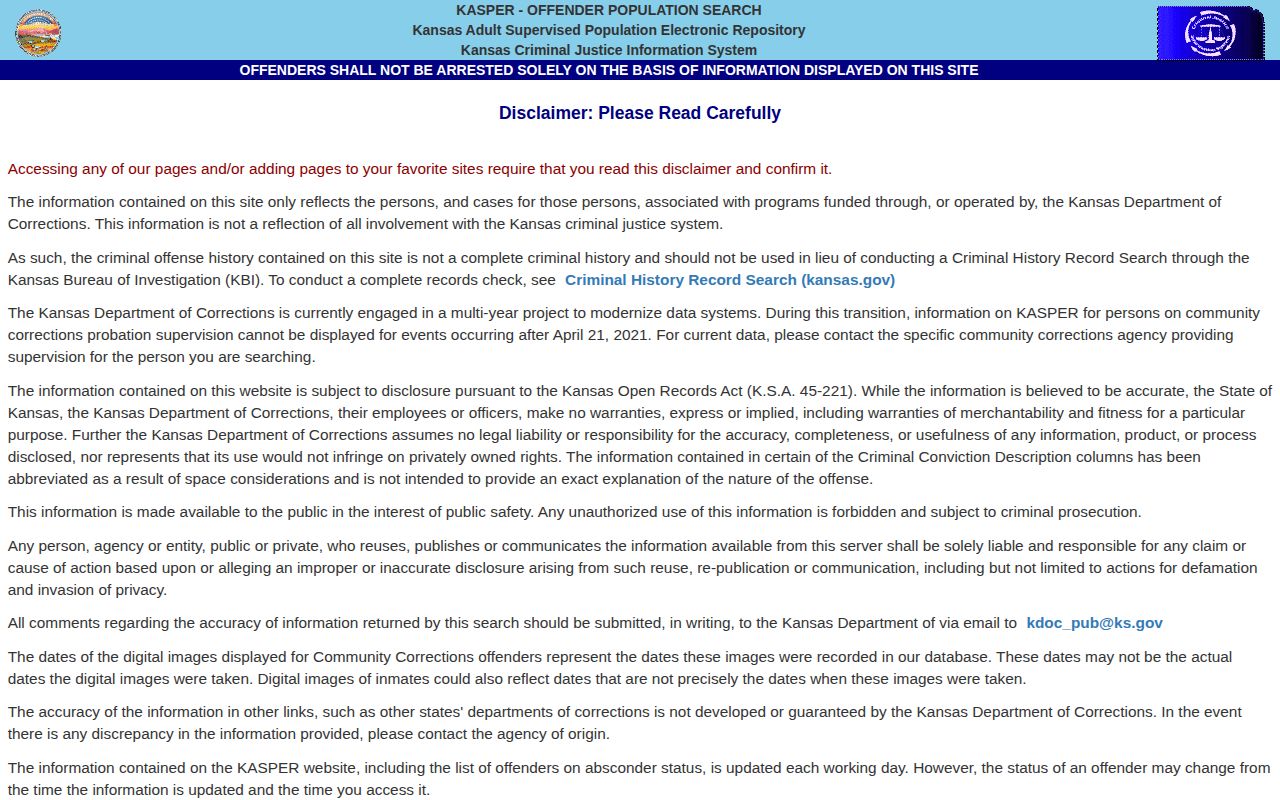
The search supports state-prison lookup, not a short Kiowa jail booking or proof that release occurred.
Kansas Good Time for Release Dates
K.S.A. 21-6821 sets several maximum-credit categories. For the general Kansas prison category involving crimes committed on or after July 1, 1993, good time is capped at 15% of the prison portion. That cap produces the common “85%” shorthand. It is not a universal promise that each person serves exactly 85%.
Specified nondrug severity levels 7 through 10 committed on or after January 1, 2008 can have a 20% maximum. Specified drug severity levels and date bands can also fall in a 20% category. Eligible people serving only designated severity-level offenses may earn up to 120 additional days for successful completion of qualifying programs, subject to exclusions and rules for multiple sentences.
Credits are conditional. Conduct, program eligibility, the offense, sentence date, consecutive terms, and sentence structure affect the result. For some offenses, credit removed from the prison portion is added to postrelease rather than ending the whole state obligation.
The Kansas good-time statute is the source for these limits.
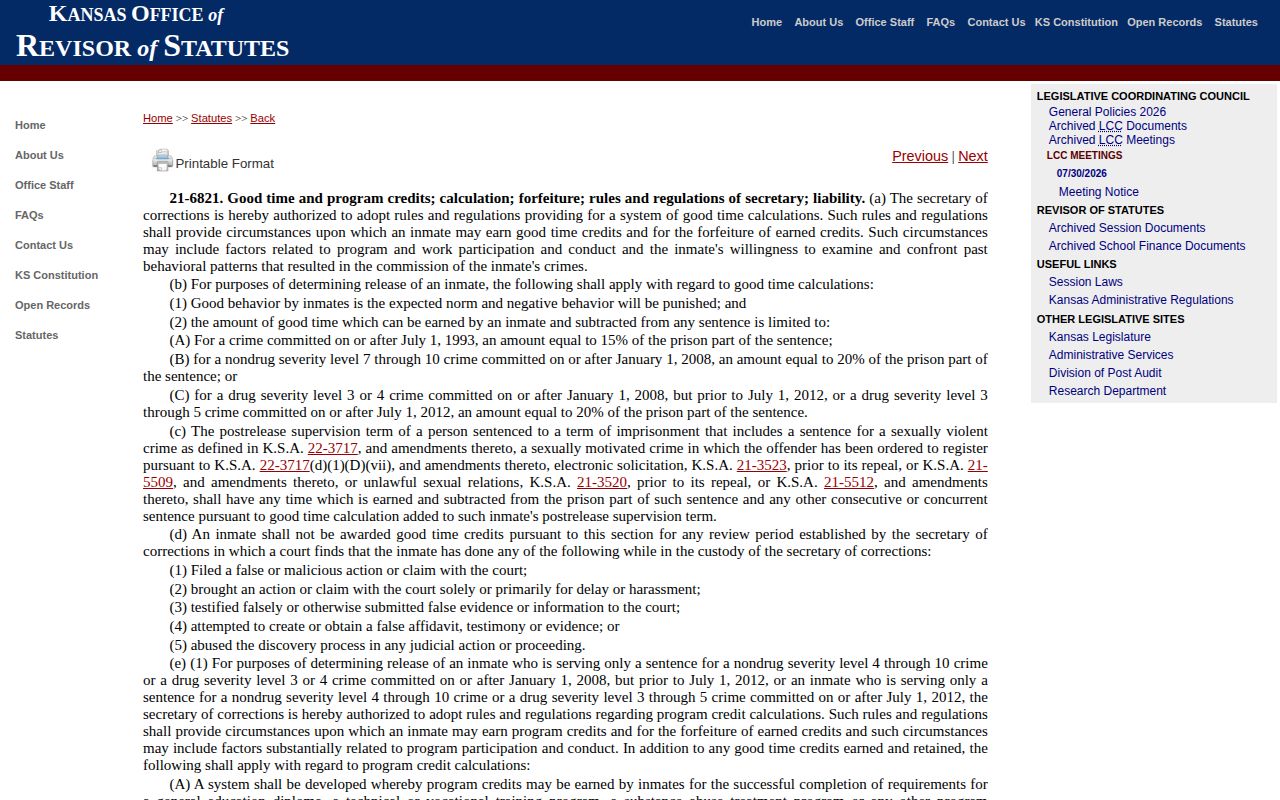
The statute must be matched to the person’s offense and sentence rather than used as a one-rate calculator.
Why Kiowa County Release Dates Change
A projected date can change without any error in the search. The estimate reflects the sentence and credits as then computed. A later disciplinary outcome, corrected jail credit, new court order, consecutive term, or outside hold can alter when the person leaves one custodian or where the person goes next.
| Factor | Possible effect | Best source |
|---|---|---|
| Good-time loss or restoration | Moves the computed prison date | KDOC sentence record |
| Program credit | May reduce eligible time within statutory limits | KDOC and K.S.A. 21-6821 |
| Jail credit or sentence correction | Changes time credited to the sentence | Court journal entry and KDOC |
| Consecutive terms | Extends the combined computation | Sentencing orders and KDOC |
| Detainer or warrant | May cause transfer instead of community release | Holding and receiving agencies |
| Parole decision | Eligibility or a decision affects applicable older sentence paths | Prisoner Review Board and KDOC |
A court order can authorize release before the jail completes processing. Likewise, a move from Kiowa’s physical custody location to KDOC or another county ends one custody placement but is not a community release. State the event, source, and agency rather than collapsing each move into “released.”
Confirm Kiowa County Actual Release
For an adult county-jail person still in custody, the Kiowa County VINELink release check can provide notice of a reported release, transfer, escape, or other change. Kansas VINE excludes KDOC prison offenders, so it is not the confirmation tool for a Kansas prison date.
Call the Kiowa jail at 620-723-4155 for current operational status. Ask whether the specific booking closed, at what time, for what reason, and whether another agency received the person. When the roster Location names a housing jail, ask Kiowa which custodian owns the physical event. For a durable record, request the release date, time, type, releasing agency, and destination if public.
For state prison, compare the updated KASPER record with KDOC or the supervising office. A status that changes to parole or postrelease means confinement ended but supervision continues. Final discharge is a later event.
Kansas Sentence Systems Affect Release
The KDOC Prisoner Review Board process distinguishes older indeterminate sentences, generally tied to crimes before July 1, 1993, from modern determinate sentencing-guidelines cases. An indeterminate sentence may involve parole eligibility and a discretionary suitability decision. Many modern determinate sentences move to postrelease supervision after the computed prison term.
Under K.S.A. 22-3717, parole eligibility for applicable sentences depends on the imposed minimum, allowed credit, offense, date, and many exceptions. Eligibility means the person may be considered. It does not establish a Board grant, physical departure, or final discharge.
The sequence can include eligibility, Board action where applicable, administrative processing, physical release, supervision, and discharge. Each is a separate milestone. Ask which milestone an official date describes before repeating it as an inmate release date.
Kiowa County Good-Time Limits
No Kiowa County jail good-time policy was found. No official local weekend-release rule or Friday-instead-of-Sunday practice was verified either. That absence matters because KDOC’s 15% and 20% prison categories cannot be copied onto a local jail sentence.
For a Kiowa County jail term, ask the jail and sentencing court how jail credit and the local sentence were computed in that case. Use the booking number and case number. If staff give a future estimate, ask what could change it and which agency will create the completed release event.
The Kansas “85%” shorthand describes only the 15%-maximum statutory category. Other categories may allow up to 20%, and some eligible program completions may produce up to 120 days. None of those figures creates an automatic entitlement. The person-specific KDOC computation and current official record control.
Do not subtract a percentage from the sentence announced in court and publish the result as a release date. The prison portion, jail credit, consecutive or concurrent structure, credit eligibility, and postrelease component all matter. A person may also have another jurisdiction’s detainer that changes the destination even when one sentence reaches its computed end. The responsible records office can explain which date a current display represents.
Request a Kiowa County Release Date
The Sheriff’s services page provides a formal route when the current roster cannot answer a past-release question. Ask for the adult booking and release record tied to the name, alias, booking number, and narrow date range. Request the booking date and time, release date and time, release type or legal basis, releasing agency, and receiving agency or destination if transferred and public.
Kiowa instructs requesters to return its form in person or by mail to 200 E Wisconsin Ave, Greensburg, KS 67054, or by the listed email route. The office states that report copies cost $10 and pictures add $1 per page in its report-copy context. Those posted amounts do not prove that every release-log request has the same final price. Ask for a cost estimate before extensive work.
Under K.S.A. 45-218, an agency must act on an open-records request as soon as possible and by the end of the third business day. That is a response deadline, not guaranteed final production. If delayed, ask for an estimated production date. If part is closed, request segregable open portions and the legal basis for withholding.
Distributed custody can affect routing. The Kiowa booking record may identify another county in the Location field. Ask Kiowa whether its office or the physical custodian owns the release event. Preserve any referral, then name it in the follow-up request. This creates a record trail and helps distinguish a transfer from a true community release.
Read Kiowa County Date Labels
Never shorten an official label when the distinction changes its meaning. “Projected,” “tentative,” “parole eligible,” “conditional release,” “released to supervision,” and “discharged” describe different points. Capture the label, date checked, record status, and responsible agency. If the KASPER record does not show the field expected, do not infer it from sentence length.
A past date also needs context. It may reflect the end of one prison term, release to supervision, a prior event before revocation, or a projection that later changed. Review the newest official entry and ask KDOC to resolve an apparent conflict. For a county booking, use the jail event log rather than a prison calculation.
The strongest conclusion names the source and event: the jail recorded bond release, the court ordered discharge, or KDOC confirmed release to postrelease supervision. That phrasing is more accurate than saying only that the person “got out,” and it preserves the difference between leaving a facility and ending all legal supervision.