
Kiowa County Parole Versus Probation
Release from confinement and release from legal control are not the same event. KDOC Parole Services supervises people released from Kansas correctional facilities on parole, postrelease supervision, or conditional release. It also handles accepted interstate-compact cases. Community-corrections probation is tied to a judicial-district program. Other probation may be managed by court services. The sentencing record identifies which path applies.
That split matters in Kiowa County. A short county-jail stay does not by itself create a KDOC parole record. A Kansas prison release may end confinement but begin parole or postrelease supervision. Probation usually comes from a court sentence that allows the person to remain in the community under stated terms. The following comparison keeps the authorities and records separate.
| Status | How it begins | Kiowa County verification route |
|---|---|---|
| Parole | Conditional release from an eligible prison sentence after a suitability decision | KASPER, then Hutchinson Parole Office |
| Postrelease supervision | Supervision following many modern determinate Kansas sentences | KASPER, then Hutchinson Parole Office |
| Community-corrections probation | Court-ordered community sentence through the judicial district | 16th Judicial District Community Corrections |
| Court-services probation | Court-ordered probation handled through court services | Sentencing court and its assigned office |
A record may move through several stages. “Released on supervision” means physical confinement ended while legal duties remain. “Discharged” means the supervision obligation ended. “Revoked” generally means supervision was withdrawn after process and the person may have returned to custody.
- Parole
- Conditional community release for an eligible prison sentence.
- Probation
- A court-ordered sentence served in the community under conditions.
- Postrelease supervision
- Supervision that follows the prison part of many Kansas determinate sentences.
- Discharge
- The formal end of the supervision obligation.
Verify Kiowa County Post-Release Supervision
Begin with the last reliable custody and sentence fact. The KASPER disclaimer and search entry explains that the database covers KDOC-associated custody and supervision, not every short county-jail booking. Search by name and, when known, a KDOC number, alias, birth date, conviction county, supervision county, location, facility, or supervision type. Avoid using sensitive identifiers when common fields can distinguish the person.
- Confirm whether the sentence was a Kiowa County jail matter, a Kansas prison sentence, or a court-ordered probation case.
- For a KDOC case, search KASPER and read the custody or supervision context without guessing at an uncaptured status label.
- If KASPER points to parole, postrelease, or conditional release, call the Hutchinson Parole Office and provide the name and KDOC number.
- For community-corrections probation, contact the 16th Judicial District office because recent events may be missing from KASPER.
- Check the sentencing court when the record indicates court-services probation or when the responsible program remains unclear.
KASPER says community-corrections probation events after April 21, 2021 cannot be displayed during KDOC modernization. That data gap is substantial. A missing modern probation event does not show discharge, noncompliance, or an error in the court record. The Dodge City office is the direct source for that category.
Kiowa County Parole Office Route
The KDOC parole contact directory assigns Kiowa County to Hutchinson. That office is the correct follow-up when KASPER connects a person to parole, postrelease supervision, conditional release, or an accepted interstate case. It also covers several nearby counties, so state the Kiowa County connection when asking staff to route the inquiry.
113 W. 1st St.
Hutchinson, KS 67501
620-669-0175
The office can resolve supervision details that a working-day database update has not yet reflected. It should not be used to confirm a person whose only known event was a Kiowa County jail booking. For that case, first use the booking record, court disposition, and the correct probation authority. The broader Parole Services page describes the population supervised by KDOC field staff.
The manifest includes a successful image matched to this topic. The official KDOC contact directory shows the Kiowa-serving route.

The directory is useful for routing, while the individual case record remains the source for the person’s status.
Kiowa County Probation Office Route
The KDOC community-corrections map identifies 16th Judicial District Community Corrections as Kiowa County’s important probation fallback. The office is in Dodge City, not Hutchinson. On the research date, the map identified Sonja Channell as director. Use the current official map to recheck staff before relying on a name.
208 W. Spruce St.
Dodge City, KS 67801
620-227-4564
This route is not a duplicate of parole services. It addresses judicial-district community corrections, and the known KASPER gap makes direct confirmation especially important. If the court placed the person under court services instead, use the court record to identify that office. A probation order, later modification, violation filing, revocation, and discharge can appear at different points on the docket.
The official community-corrections map documents this distinct Kiowa County route.
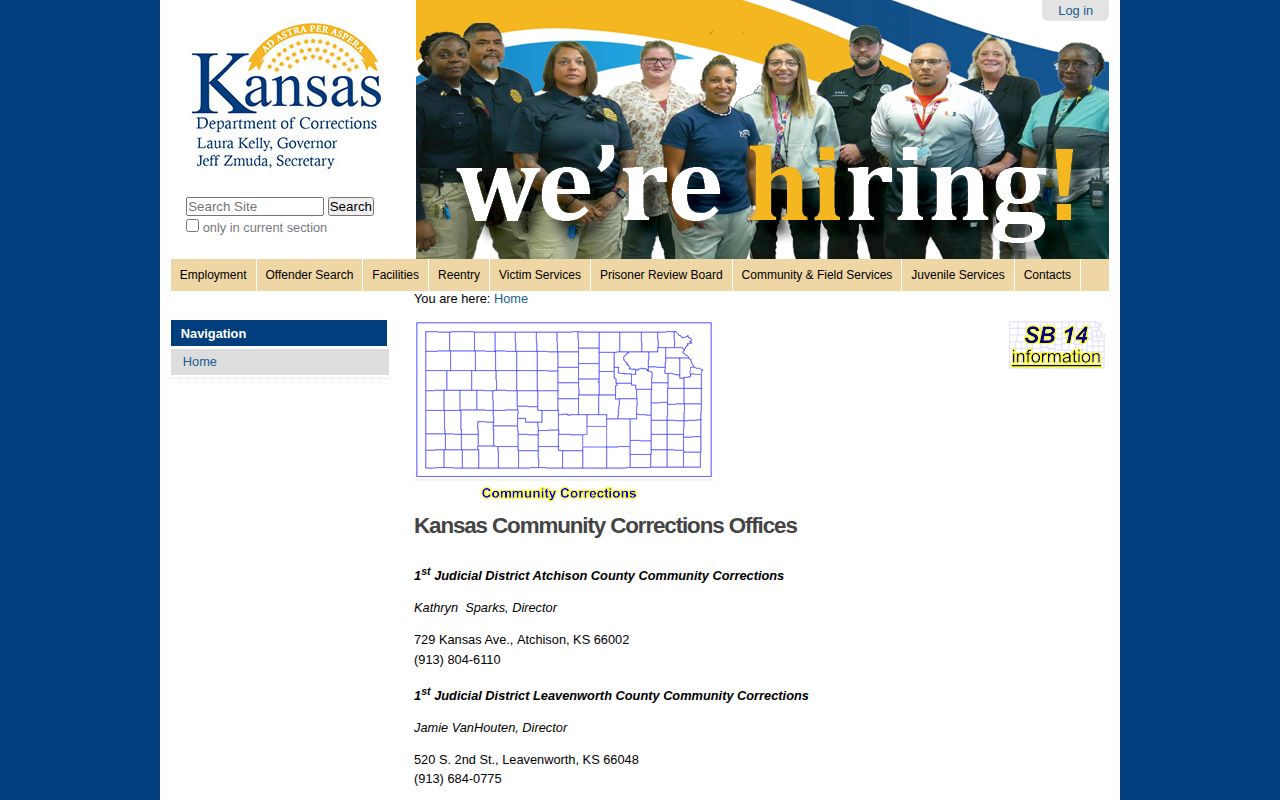
The map reinforces why parole and probation inquiries should not be sent to one generic office.
Kiowa County Warrants and Absconders
Kiowa County and KDOC publish different warning records. The Sheriff’s local warrant list displays name, warrant number, charge, bond, and date. KASPER provides separate lists for parole absconders and community-corrections absconders. KDOC states that these sources update each working day.
An absconder is a person alleged to have stopped reporting or otherwise left supervision without authorization. The listing signals an alleged supervision problem or wanted status. It does not prove the person is in custody now, nor does it supply an arrest command to a member of the public. A local warrant may explain a hold or a later return to confinement, but only the issuing or supervising authority can confirm what remains active.
KDOC directs tips to local law enforcement or its Enforcement, Apprehensions, and Investigations Unit at 785-414-7755. Do not approach a listed person. For record verification, compare identifiers and contact the office behind the entry.
The Kiowa warrant page illustrates the local fields and its need for verification.
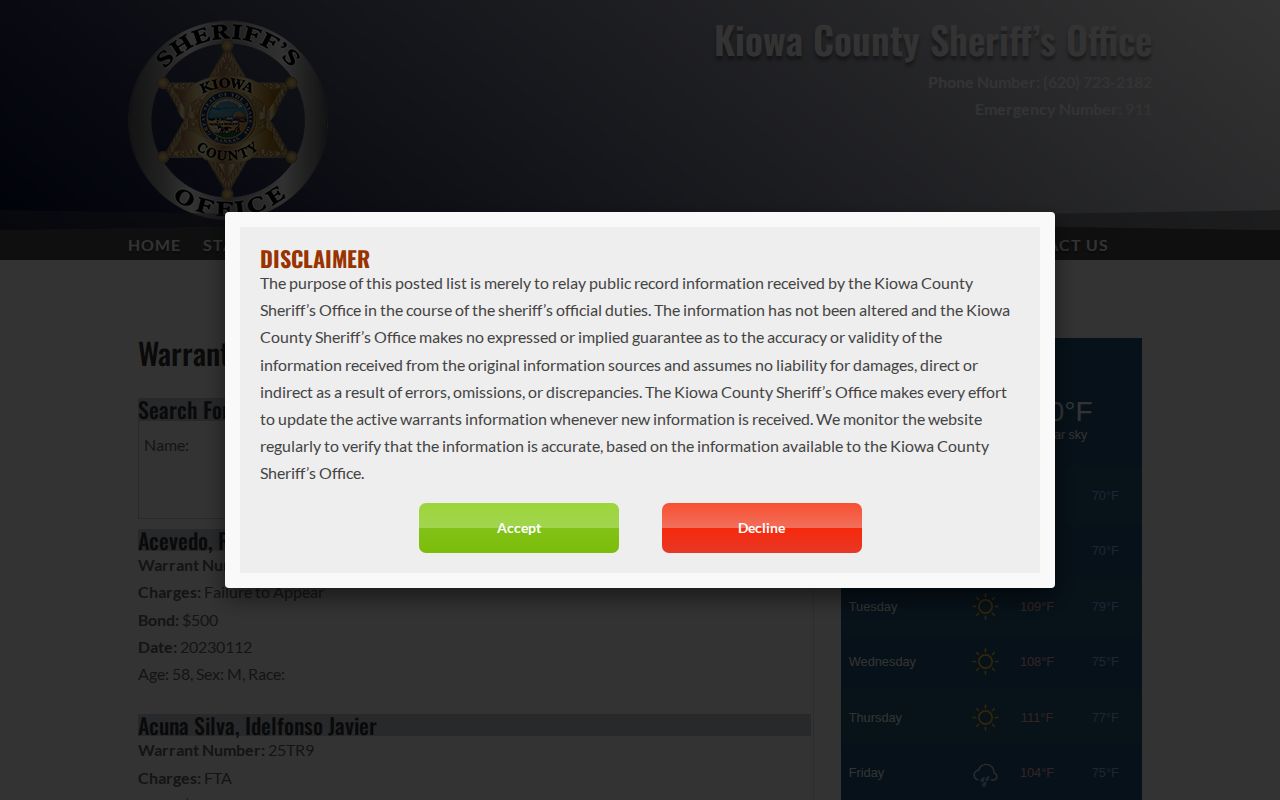
The page is a warrant lead, not proof of present custody or completed release.
Note: A warrant, absconder listing, roster absence, and discharge record each answer a different question and should never be treated as interchangeable.
How Kiowa County Supervision Ends
Active supervision may end through formal discharge, or it may change through modification, revocation, return to custody, or transfer of supervision. “Released from prison” is therefore not the same as “off supervision.” The best record set pairs the current KASPER context with the supervising office and the sentencing court’s latest public entries.
Kansas law also makes the discharge date relevant to later expungement timing. Under K.S.A. 21-6614, waiting periods for eligible matters run from sentence satisfaction or discharge from probation, community corrections, parole, postrelease, conditional release, or a suspended sentence. The rule contains different periods and exclusions, so the signed order and official discharge record matter more than an old screen.
The full Kiowa County booking and release path is explained on the Kiowa County released inmates home page. For supervision, request the exact discharge entry from the custodian rather than treating a blank search as final proof.
A careful request names the status being tested. Ask whether supervision is active, transferred, revoked, or discharged, and ask for the effective date of the latest public event. If the answer refers to another office, record the office name and the date of the referral. This avoids turning a brief “not supervised here” response into a claim that no Kansas authority supervises the person. Interstate cases can also move the day-to-day contact while KDOC retains an official role.
The court and the field office answer different parts of the question. A court docket can show the sentence, probation order, later violation filing, revocation, modification, or discharge. The supervising office holds the current operational status. Pairing them helps explain why an older order and a newer KASPER or office response may appear to conflict.
Correcting Kiowa County Supervision Records
An expungement or correction may not appear everywhere at once. The KBI expungement fact sheet says that after KBI receives a certified order, its processing and notice to the FBI, KDOC, and involved Kansas agencies takes about two to four weeks. A lingering display during that period does not override the signed court order.
Preserve the certified order and note the date it was sent. Contact the custodian of a stale display with enough detail to identify the record, but avoid sending sensitive information that is not needed. If the issue concerns a KDOC supervision record, start with the responsible parole or community-corrections office. If it concerns a court docket, use the court clerk and the order entered in that case.
This delay is one reason to distinguish a legal change from a database refresh. It is also why an old screen should not be used to declare that Kiowa County parole or probation remains active after an official discharge or expungement order.